

THE proposed Civil Aviation and Immigration Security Services (CAISS) project is designed to fill the gap and enhance existing government border security systems, not duplicate them, according to Nate Carpenter, chief technology officer of Securiport LLC.
In a recent online interview with reporters on the sidelines of the 21st International Civil Aviation Organization (ICAO) Traveller Identification Program (TRIP) Symposium held in Montreal, Canada, Carpenter responded to concerns that the project would overlap with systems already funded and operated by the government.
“This is actually not a duplication at all. We built our system at Securiport to fit into the government’s ecosystem,” Carpenter said.
He said governments already have purchased technologies and established systems.
Securiport’s tools are meant to work within that ecosystem and add capabilities, information, and risk-identification tools.
“They do not replace the systems that are there. They enhance the systems that are there. We look at it as multiplying the government’s investment that they’ve already made,” he said.
Carpenter spoke at the September 22–24 annual event that brought together Member States and stakeholders from passport and civil-registry offices, border and law-enforcement agencies, aviation security and public-health authorities, airlines, and airports, international organizations, and industry experts to explore ways to make travel more seamless, secure, and efficient.
Themed “Putting Trust into Practice: Towards Trusted Travel Identity for All,” he said discussions focused on advancing traveler identification, border security, privacy safeguards, and system interoperability, and aligning with ICAO standards, which are seen as key to delivering safer and smoother journeys.
Beyond an API upgrade A Bureau of Immigration (BI) officer earlier said the current Advance Passenger Information (API) system launched in March 2025 covers 97.88% of international flights nationwide. The upgrade to CAISS, however, is not limited to shifting from batch API to interactive API.
While API tells authorities who is expected, CAISS, as an intelligence layer, verifies who is actually, present and helps turn that information into a controlled, traceable border decision.
“Yes, we’re moving from batch API to interactive API,” the officer said. “But that’s only part of the picture.”
The P10.7 billion Public-Partner Partnership project also seeks to integrate Passenger Name Record (PNR) data, which becomes available four to 48 hours before departure. PNR includes booking patterns, payment methods, email addresses, travel frequency, and even seat assignments, providing intelligence that helps detect transnational crimes before travelers even board.
“If you’re using cash, that’s a red flag,” the officer said, adding that API and PNR are only part of CAISS.
Integration, key to border security upgrade CAISS’s strength is its integration, which would allow authorities to cross-reference travel patterns, social media activity, and previous records. It would also enable one-to-many biometric matching, in which facial, fingerprint, and iris scans are checked against historical records.
Current systems generally use one-to-one verification, or one passport against one person. The integrated system won’t be limited to airports. It will eventually cover seaports, land borders, and traditional sea routes in the southern Philippines—strengthening borders across the archipelago.
E-gates, automated border control Carpenter said e-gates and automated border control are also part of any modern border solution. “It allows—we call them automated border control or ABC—because it’s essential to processing large volumes of travelers that you have e-gates, that you have electronic kiosks, for example, and that you have contactless technology to allow people just to walk across through a corridor to the border,” he said. “All of these have their own purpose.”
He said Securiport’s system integrates with BI’s current e-gates project. “Our system integrates with e-gates. We are happy if the government has them,” Carpenter said, adding that Securiport has done this with multiple clients.
Carpenter’s statement clarified an online news report that the BI’s Sept. 19 bidding for Phase II of its E-Gates expansion, worth P1.347 billion, raised questions about how it differs from the separate P10.7 billion CAISS project, which also includes automated immigration and biometric technology.
SECURITY AND FACILITATION
The BI officer said that capability is key, noting that one-to-many matching could flag discrepancies such as a face matching a different name.
Integration would serve both security and facilitation. Pre-vetting passengers through API, PNR and biometrics would allow authorities to focus scrutiny on high-risk individuals while allowing low-risk travelers to pass through e-gates faster.
“Long queues happen when you don’t have a targeting center,” the officer said. “With integration, you predetermine who needs scrutiny and who doesn’t—making processing faster and safer.”
BI said viewing API and PNR as separate tools misses the point, as the unsolicited CAISS— which underwent an uncontested Swiss challenge—is designed to unify both data streams into a single platform.
Like APIS, which complies with ICAO biometric and border security standards and practices, CAISS includes advanced passenger information systems, automated border control with contactless face pass, biometric kiosks, criminal record search engines, and deception detection tools.
ICAO is a UN specialized agency based in Montreal that sets standards for international air navigation.
BI hopes to begin implementation as early as December or next year, with full modernization targeted within two to three years and a 4-year refresh cycle over a 20-year period.
“BI is dreaming of a modern immigration,” the officer said. “That is the dream of our President —to modernize our borders, strengthen security, and show the public faster, safer processing.”
 DIESEL PRICES TO DROP BY OVER P7 PER LITER
  PROSECUTION PIECING TOGETHER ‘WEALTH PUZZLE’ IN VP SARA TRIAL – CHUA
  EDUCATION MARCOS ADMINISTRATION’S HIGHEST PRIORITY
  PALACE ORDERS PROBE INTO ATHLETES’ FUNDING COMPLAINTS
  GOVERNMENT BRACES FOR ‘VERY STRONG’ EL NIÑO, URGES PUBLIC TO PREPARE
  MANIBELA TO HOLD 3-DAY TRANSPORT STRIKE
  CAISS PROJECT TO ENHANCE, NOT DUPLICATE PH BORDER SECURITY SYSTEMS – SECURIPORT CHIEF TECHNOLOGY OFICER
 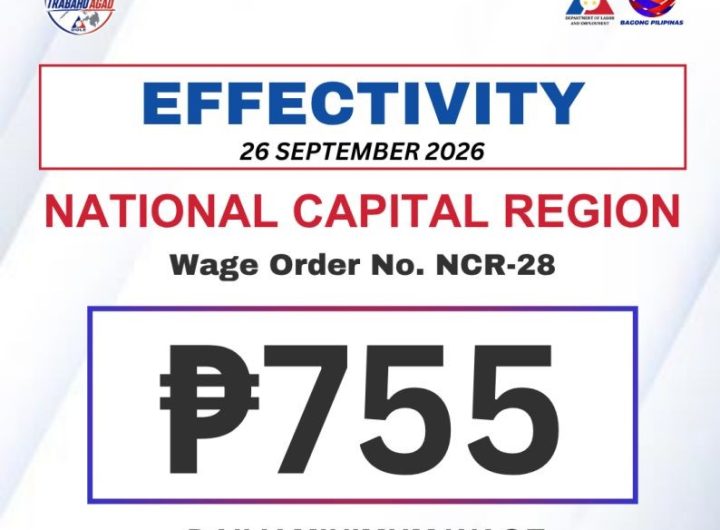 P755 NEW DAILY MINIMUM WAGE FOR METRO MANILA WORKERS